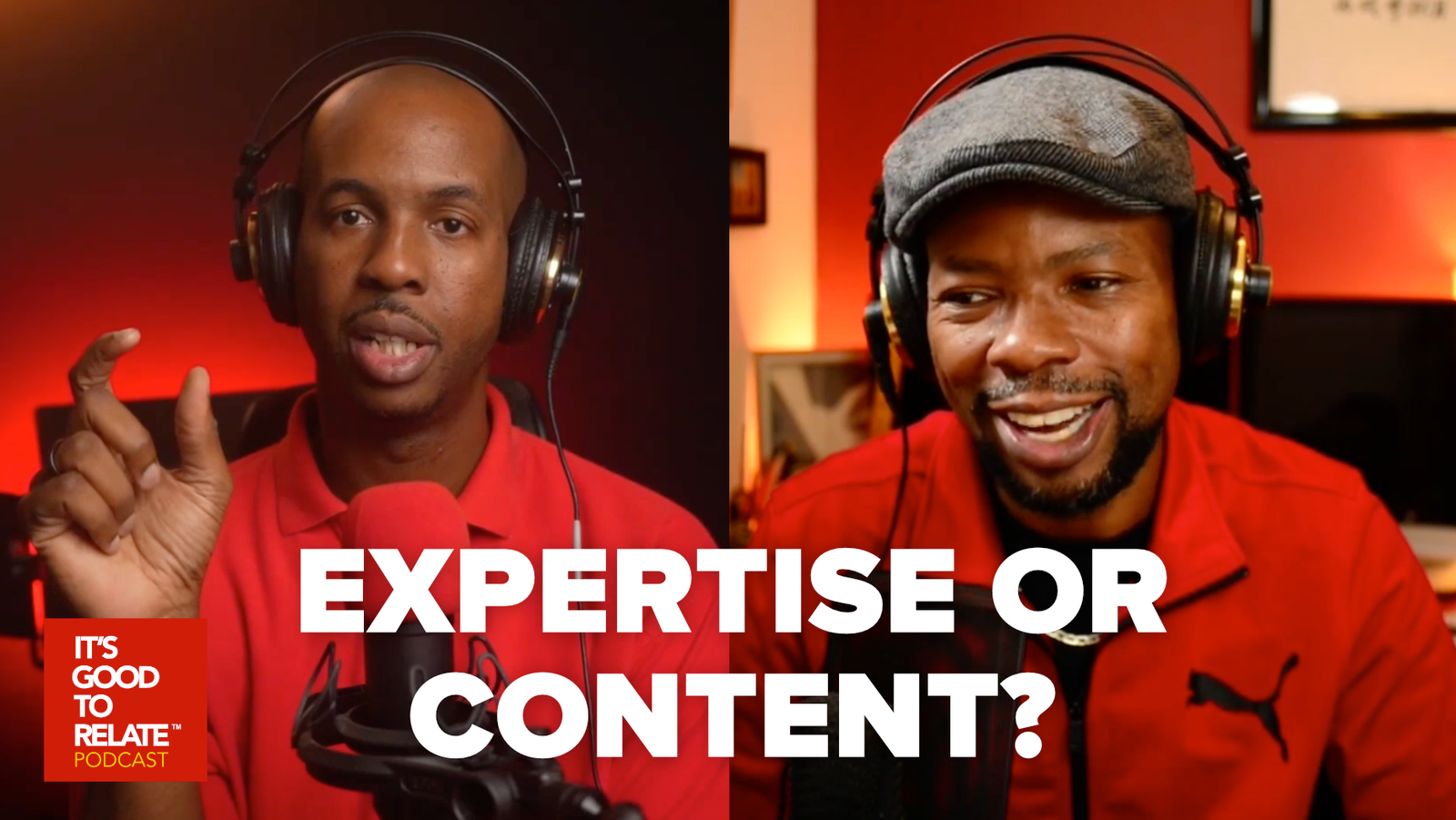


Episode 16 Summary:
Monetize Your Mind vs. Monetize the Attention: The Two Paths to Content Success
Every startup founder and CEO eventually faces the content monster. You know you need a digital presence, but the advice out there usually conflicts. Should you dance on TikTok to humanize your brand, or publish dry, 4,000-word whitepapers on LinkedIn?
In this episode their video podcast, marketing strategists Juma Bannister and Ayinde Smith broke down this dilemma beautifully. They revealed that content marketing isn’t a monolith; instead, it splits into two distinct strategic pathways: the Creator Professional versus the Professional Creator.
If you are trying to scale a business, choosing the wrong lane won’t just waste your marketing budget—it will break your strategy entirely. Here is how to identify which path you belong in, and how to leverage it for high-conversion growth.
Path 1: The Creator Professional (Expertise-First)
The Creator Professional is a master of their craft who uses content purely as a leverage point. They are not chasing internet fame; they are chasing business growth, authority, and enterprise value. As Juma Bannister neatly summarized:
“The creator professional… these are the people who are professionals before they are creators… they really aren’t trying to be famous, they’re trying to use content as a way to scale their business or build their personal brand.”
Ayinde Smith clarified the mechanics of this dynamic perfectly during the discussion:
“He’s a professional first and a creator to support the professional… he uses content creation to promote his expertise, whether it’s personal or business.”
The “Monetize Your Mind” Framework
For a B2B startup, a SaaS platform, or a consultancy, this is your default lane. You already have a product, a service, or a specialized skill set. Content is simply the bridge that connects your internal brilliance to the market.
Consider the local success story of Renee Andrews, owner of the Trinidadian artisan ice cream brand, Sorvete. Exhausted after an 18-hour kitchen shift, she forced herself to post a raw video detailing her day’s hard work. By the next morning, her inventory completely sold out online. The content didn’t create her expertise; it leveraged it.
The Golden Rule for CEOs in this lane:
“You don’t really need millions of views, you just need the right views from the right people.” — Juma Bannister
Path 2: The Professional Creator (Content-First)
On the flip side sits the Professional Creator. These are your traditional internet creators and influencers. They don’t start with a manufacturing facility, a software tool, or a law degree; they start with a camera, a unique perspective, and an obsession with storytelling.
This is the “build an audience first, figure out the business later” path.
While it looks glamorous from the outside, Ayinde and Juma highlighted the massive operational risk built into this model. When a creator builds a massive audience based entirely on entertainment without a backend business structure, they hit a dangerous wall. Juma framing the core dilemma of the content-first creator notes:
“Now that I’ve found all this attention, what am I gonna do with it? That’s the dilemma the creator has.”
The Monetization Struggle
Traditional influencers win on charisma and retention, but they frequently struggle with conversion because they lack a core product. For example, local creator Certified Sampson created content for seven years without making a single cent before finally unlocking brand sponsorships and brick-and-mortar business integrations.
For a startup CEO, trying to act like a Professional Creator (chasing viral trends and generic reach) is usually a distraction. Unless your business model relies entirely on ad revenue or mass-market merchandise, vanity metrics will eat your ROI alive.
The Hybrid Pivot: Can You Do Both?
Can an expertise-first business pivot into pure entertainment, or vice versa?
The hosts pointed to local creator Zack Bermudez (Sharp Shop / ZachBDZ), who initially utilized sharp, high-end video content to drive his manual knife-sharpening business. Over time, he built a massive secondary following based entirely on comedy and entertainment, effectively shifting lanes to land corporate brand deals while keeping his backend business operational through automated web systems.
Similarly, international figures like agency executive Chris Do (The Futur) transitioned from running a client service agency to treating education and media as the primary business.
But beware: shifting lanes requires an entirely different operational infrastructure.
The Head-to-Head Comparison
To help you audit your current marketing strategy, look at how these two pathways stack up against each other:
| Metric / Attribute | The Creator Professional (Expertise-First) | The Professional Creator (Content-First) |
|---|---|---|
| Starting Asset | A proven technical skill, product, or professional background. | Passion for media, storytelling, and community building. |
| North Star Metric | Conversion & Authority. (Did this drive a lead or solve a client’s problem?) | Retention & Reach. (Did they watch the whole video? Did they share it?) |
| Core Trait | Clear, actionable, and educational. | Engaging, charismatic, and entertaining. |
| The Primary Trap | Overcomplicating production values and fearing the camera. | Burnout and struggling to figure out how to monetize the attention. |
What did we learn today?
- Strategy Dictates Format: You must choose your path before hitting record. Building an audience to sell to later requires an entirely different strategy than creating content to support an existing business.
- Views Are Vanity, Relevance is Sanity: If you are a Creator Professional, stop comparing your metrics to lifestyle vloggers. High-intent views from ten qualified decision-makers are worth more than a million views from people who will never buy your product.
- The Market is Unforgiving: Content marketing is highly competitive, and corporate ad dollars are limited. As Ayinde Smith noted, “It’s a combination of different things that kinda drive success… and it’s highly competitive.” Consistency is your baseline requirement, but true alignment with your brand’s actual business model is what drives revenue.
- Effort is not equal to Results: In the creative economy, pure hustle doesn’t guarantee a return. You need an underlying monetization framework to support the attention you capture.
Take Action
Look closely at your startup’s current digital footprint: Are you unintentionally running the playbook of a Professional Creator when your business actually needs you to be a Creator Professional?