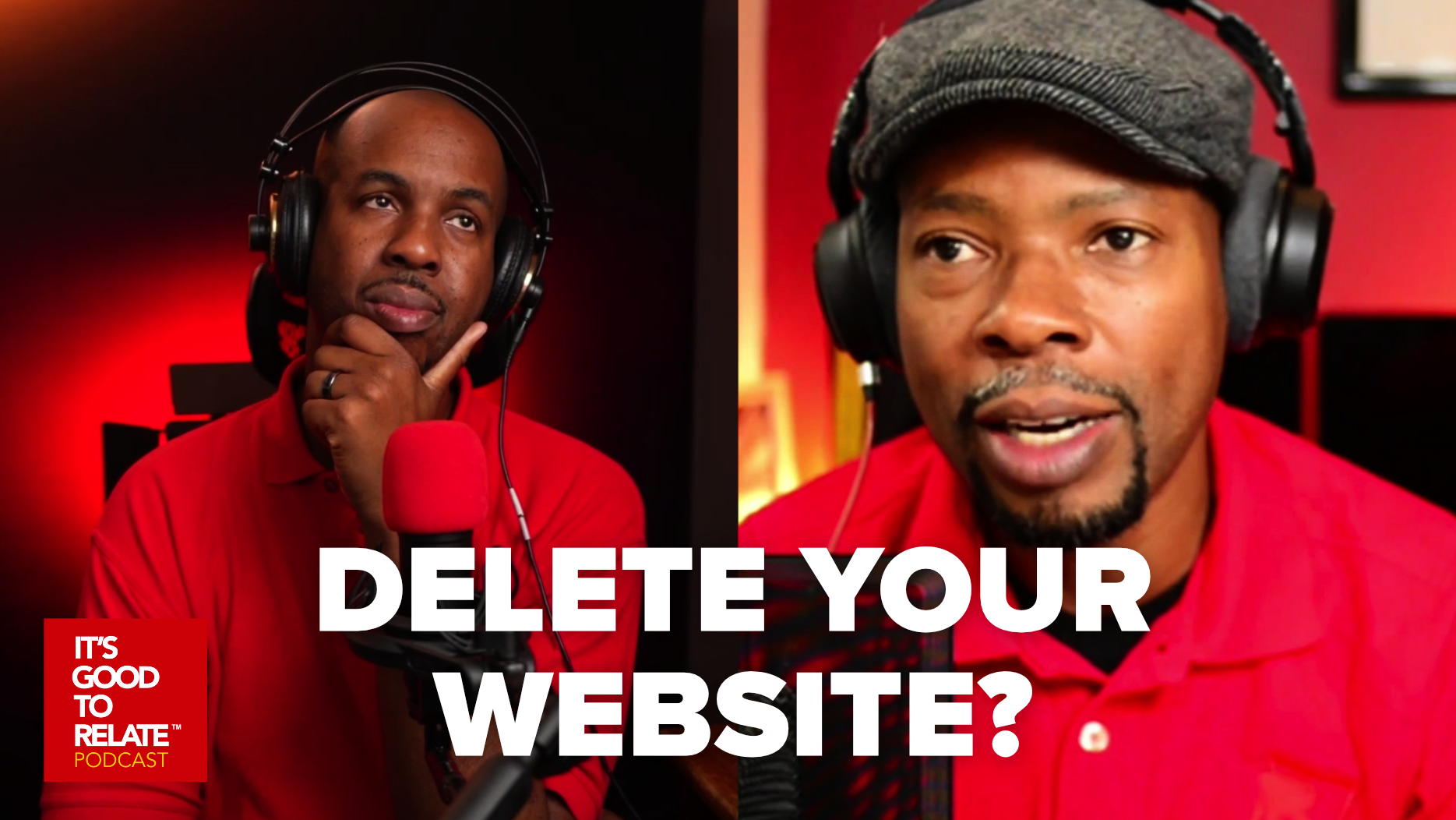


Episode 5 Summary:
The CEO’s Guide to Digital Real Estate & Un-Robotic Customer Service
If you’re running a startup, you’ve probably asked yourself two questions recently: “Do we really still need a website when everyone is on social media?” and “Why does our customer service feel so… lifeless?” In this episode of the It’s Good to Relate podcast, digital strategists Juma Bannister and Ayinde Smith tackled these exact issues. They connected the dots between your digital footprint and human connection, proving that in an age of AI summaries and automated bots, owning your platform and acting like an actual human are your ultimate competitive advantages.
Pull up a seat and let’s dive into how you can stop abandoning your customers and start building a digital ecosystem that actually converts.
Part 1: Your Website is Not Dead (But Your Strategy Might Be)
With platforms like TikTok launching in-app shops and Google serving up AI summaries that eat into click-through rates, it’s tempting to abandon your website altogether and go all-in on social media.
According to Juma and Ayinde, that’s a massive mistake.
Social media is rented land. Algorithms change, accounts get shadowbanned, and massive platforms can become irrelevant (remember MySpace?). Your website is the only piece of digital real estate you truly own.
“Social media is very good and you should be using it, but you don’t own it… You run some risk by basing your entire digital strategy just on social media.” — Ayinde Smith
Instead of viewing your website as a static digital brochure, treat it as the absolute center of your brand’s universe.
“…our websites are a part of a digital ecosystem, or if, if you may a digital marketing ecosystem… all of the dots are connected in very specific ways.” — Juma Bannister
Social media is where people discover you, but your website is where they get to know you, trust you, and eventually, buy from you. Even if AI answers a user’s initial question on Google, to actually complete a commercial transaction or engage with your brand in a real way, they still have to leave the search engine and come to you.
Part 2: The “Welcome to KFC” Problem
We have all experienced it: you walk into a fast-food chain or call a support line, and you are greeted by someone reciting a script so rigidly that you feel like you’re talking to a wall. Ayinde refers to this as the “Welcome to KFC” issue, the over-reliance on structured scripts to counter bad service.
“Good customer service then can’t necessarily be polite language. Devoid of actual human connection and response in the moment.” — Ayinde Smith
For a CEO, the lesson here is critical. You can train your team to say the exact right words, but if they aren’t empowered to actually solve problems, your customers will feel the friction. Scripts are a great baseline for standard operating procedures, but they are a terrible ceiling for customer experience.
Part 3: Empowerment over Execution
So, how do you fix dead-eyed customer service? You empower your frontline workers to be autonomous.
Juma shared a story about a local wings restaurant where the staff remembered his “usual” order but seamlessly adapted when he wanted to try something new. Ayinde shared a similar experience at a local market, where a vendor threw in a few extra sweet potatoes just to show appreciation.
These moments of personalization aren’t born from rigid corporate manuals; they happen when employees are given the flexibility to care.
“…good service happens when a human is allowed to use their brain to help another human.” — Ayinde Smith (paraphrasing Simon Sinek)
Part 4: The Sin of Post-Purchase Abandonment
Perhaps the biggest pet peeve raised in the discussion was what Ayinde coined “post-purchase abandonment.” Many companies are incredibly attentive right up until the credit card clears and then they vanish.
Marketing doesn’t stop at the sale. According to the Harvard Business Review, it is 5 to 25 times cheaper to keep an existing customer than it is to acquire a new one. If you are just moving on to the next transaction without nurturing the relationship, you are burning cash.
Whether you’re a high-end restaurant gifting a slice of cheesecake to a first-time diner to ensure they return, or a B2B SaaS company offering tailored onboarding, the goal is loyalty. You want a million relationships with your brand, not just a million isolated transactions.
What did we learn today?
-
Own Your Real Estate: Websites are still highly relevant. They serve as the central hub of your digital marketing ecosystem where social media traffic converts into actual business.
-
Ditch the Dead-Eyed Scripts: Polite language means nothing without human connection. Scripts should be a starting point, not the entire interaction.
-
Empower Your Team: Allow your employees the autonomy and flexibility to personalize the customer experience.
-
Stop Abandoning Customers: The sale is just the beginning. Focus on post-purchase care to build long-term, loyal relationships that are significantly cheaper to maintain than acquiring new leads.
Are you treating your website like a digital brochure, or are you actively using it to build a post-purchase relationship with your customers?