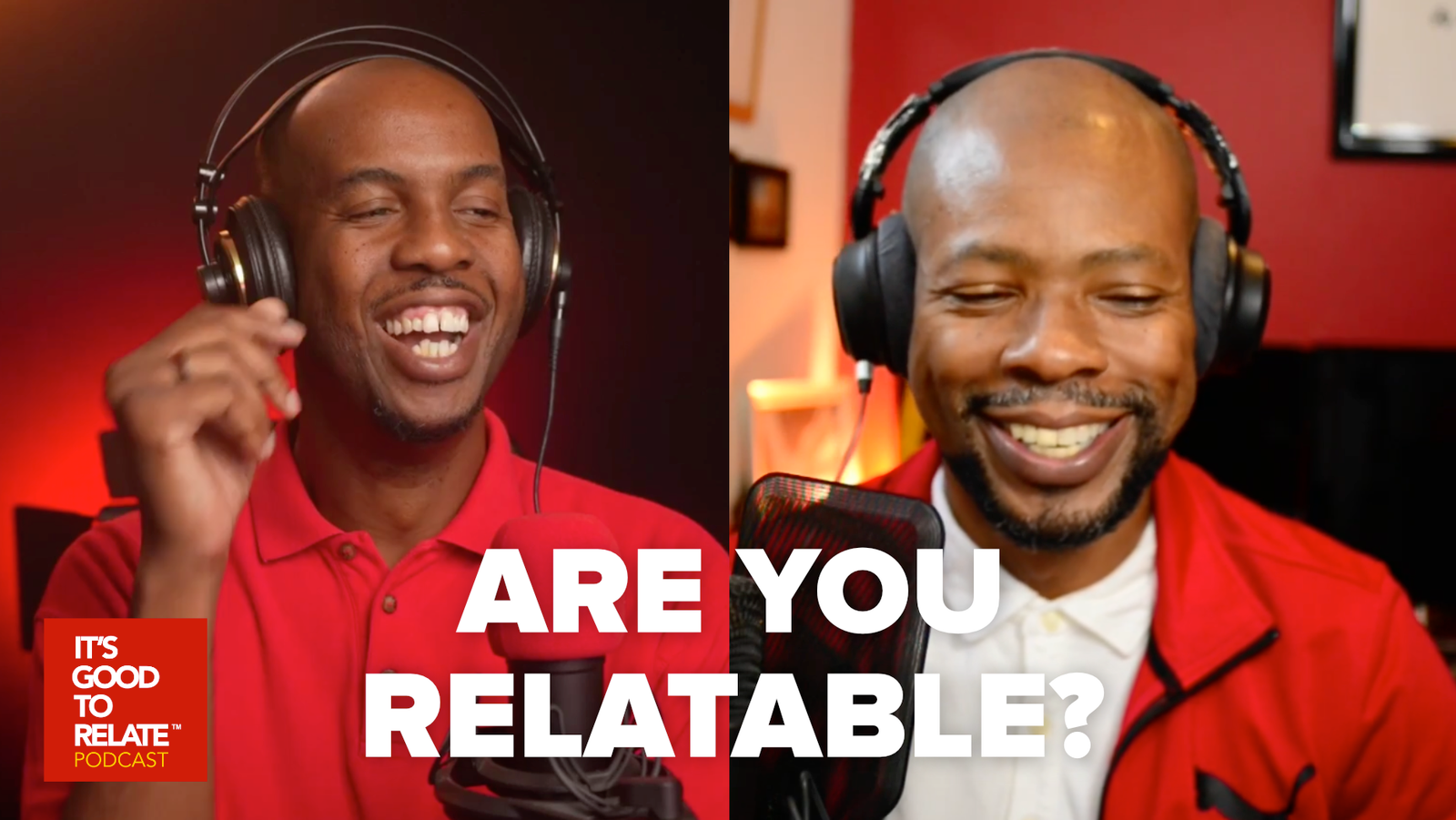


Episode 15 Summary:
The Complexity Trap: Why Your Content Isn’t Landing (And Why Video is the Future of the Annual Report)
You’ve followed the playbook. Your latest video has a hook, a solid setup, three well-articulated points, and a clear call to action. You stayed on strategy. Yet, the engagement metrics look like a flatline. No comments, no shares, and the only “like” is from your mom.
What went wrong? According to Juma Bannister and Ayinde Smith in the latest episode of It’s Good to Relate, the problem isn’t your strategy…it’s your ego.
The Curse of Knowledge and the “NIC” Problem
Most CEOs and executives suffer from the Curse of Knowledge. We forget what it’s like not to be an expert. We fall into the “Complexity Trap,” using industry jargon that makes us feel smart but leaves our audience reaching for a dictionary, or the “close” button.
Juma puts it bluntly:
“We make content for us to understand and not for the people who we want to consume the content.”
Ayinde illustrated this with a classic corporate anecdote: an IT manager once grandly announced to a room of confused artists that “The NIC is bad.”
“Everybody looking at each other like, ‘Who’s Nick?’… Eventually, we had to kind of squeeze out of him what he meant was the network interface card is not working… If you said that the first time, we would’ve known exactly what you’re talking about.”
If your audience has to pause for even a microsecond to translate your “corporate-speak,” you’ve lost the flow of the conversation.
3 Steps to Escaping the Complexity Trap
To make your content more relatable and shareable, Juma suggests three specific shifts in how you use language:
1. Turn Big Words into Definitions
If you find yourself reaching for a multisyllabic word like “decluttering,” try “cleaning up” instead. “Clean” is visceral; everyone knows what a clean room feels like. Better yet, show, don’t tell. If you can demonstrate the concept visually in your video, the words matter less.
2. Talk Like a Friend
Stop addressing your audience like you’re speaking at the UN.
“Imagine you are sitting across the table from someone that you trust. In that conversation, you’re not trying to impress anybody… your shoulders drop, your tone warms up, and you become much more relatable.”
Pro-Tip: Use voice-to-text to draft your scripts. It bypasses the “formal writer brain” and keeps your natural human cadence.
3. The Power of the Pause
In Trinidad we are known as fast speakers and some of us tend to “eat our words.” In a fast-paced business environment we may rush because we’re nervous or afraid we’ll forget the point. But there is no prize for finishing first. We we speak we should SLOW IT DOWN.
- Pacing is clarity. Give your audience time to digest.
- Vocal Punctuation. Respect your commas and full stops.
- The Oxford Comma of Speech. Use pauses as “amber lights” to tell people to slow down and pay attention.
Rethinking the Annual Report: From PDF to “Trust Document”
While Juma focused on language, Ayinde challenged the very format of corporate communication, specifically the Annual Report.
Most companies treat the annual report as a boring statutory requirement, a PDF full of people in suits standing against white backgrounds. But Ayinde argues it should be viewed as your primary Trust Document.
“The annual report is actually one of the biggest trust drivers for the organization… It’s a trust document that backs up everything that you said the year before.”
Why Video Crushes the Traditional PDF
If the goal is to build trust with investors, employees, and the public, the PDF is an inferior tool. Consider these 7 advantages of a Video Annual Report:
- Humanizes the Numbers: It puts a face (the CEO or Chairman) to the data.
- Communicates Culture: A CEO’s warmth and conviction on camera say more about the company culture than any mission statement.
- Simplifies Complexity: Explaining financial ratios via video makes them accessible to the general public, not just the financially savvy.
- Retention: Viewers retain 95% of a message in a video compared to just 10% when reading it in text.
- Shareability: People don’t text PDFs to their friends; they share videos.
- Forward-Thinking Signal: It differentiates your brand from the “sea of PDFs.”
- Longevity: A video lives forever on search engines, working harder and longer than a printed magazine.
What did we learn today?
- Clarity is Kindness: Simplifying your language isn’t “dumbing it down”; it’s opening the door for your audience.
- The 14-Year-Old Rule: Aim your content’s complexity at a 13 or 14-year-old level (Form 2 or 3). If they get it, your distracted, multi-tasking CEO audience will get it too.
- Video = Accountability: Putting your face and voice behind your year-end results creates an emotional accountability that text cannot match.
- Hybrid is the Future: While statutory requirements might keep the PDF alive for now, the “highlights” and “culture” of your year belong in video.
Does your current content strategy rely on “Synergy and Other Lies,” or are you speaking the language your customers actually use?