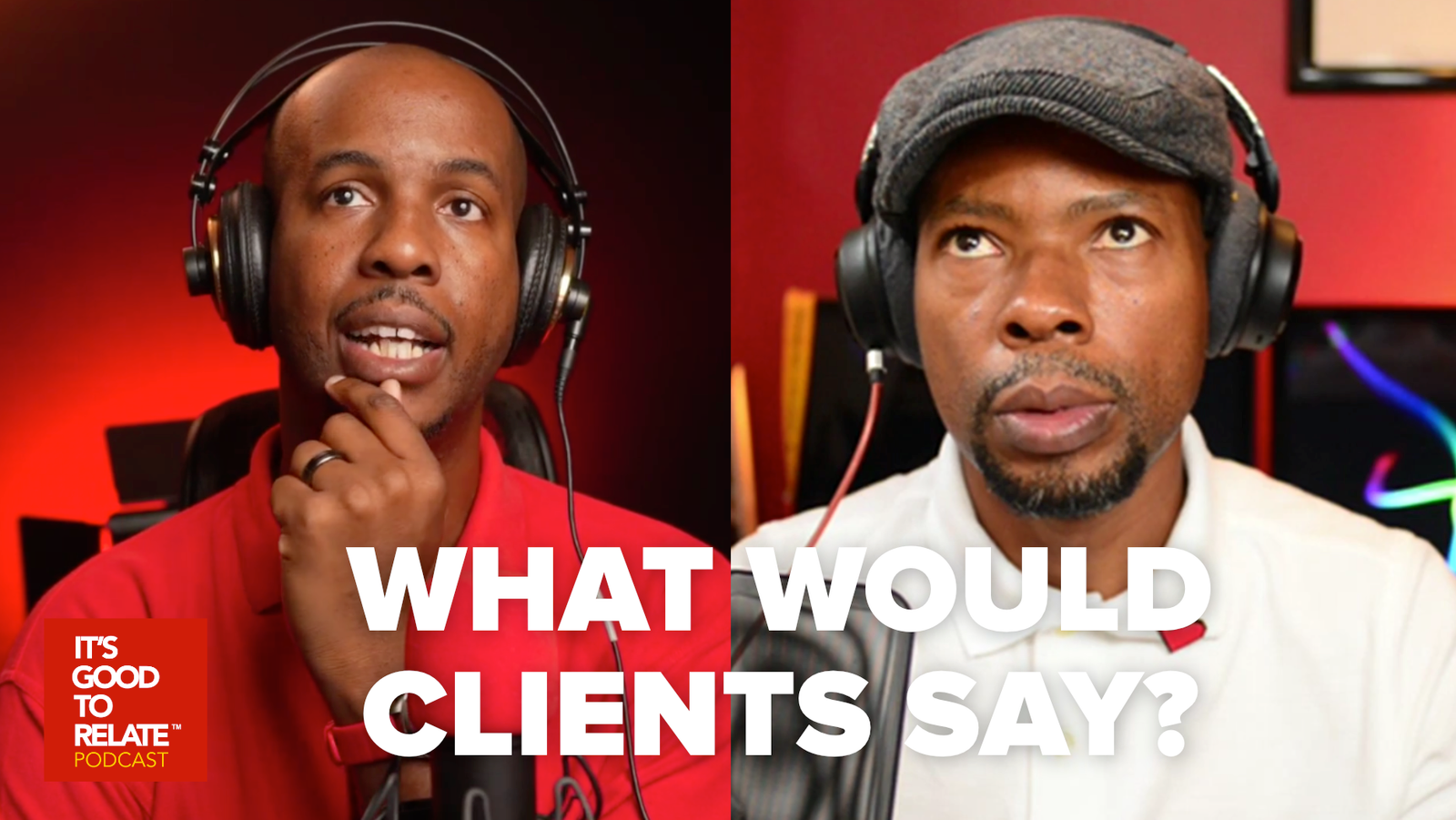


Episode 10 Summary:
The High-ROI Content Loop: Why Your Testimonials are Failing and Your Strategy is Exhausting You.
In the world of high-growth startups, time is the only currency more valuable than capital. Yet, most CEOs find themselves trapped on a “content hamster wheel,” churning out generic posts and begging for “nice” reviews that don’t actually move the needle.
In this episode of IT’S GOOD TO RELATE, Juma Bannister and Ayinde Smith broke down the two pillars of a high-conversion presence: Transformation-Based Testimonials and the Zero-Waste Content Map. If you’re tired of shouting into the void, here is how you fix your evidence and your output.
1. Stop Collecting Reviews, Start Documenting Transformations
Most B2B testimonials are, frankly, useless. “They were great to work with” or “Highly recommended” are the participation trophies of the business world. They don’t sell; they just take up white space.
Juma Bannister argues that for service-based businesses, where the “product” is intangible, the only thing that matters is evidence of change.
“In order for people to buy from you, the key thing that they need is evidence. They need evidence that you could deliver a service… social proof basically is a psychological phenomenon where people emulate the actions of other people in order to reflect correct behavior.” — Juma Bannister
The “Before and After” Logic
A powerful testimonial isn’t about how “nice” you are; it’s about the emotional and practical journey. You want your prospective clients to see themselves in the story.
“The whole crux of the matter is that there’s a particular type of testimonial that you want. You don’t want a generic testimonial, but you want a testimonial based on the transformation that you have brought to the client… Your goal is really to capture the story arc, right? What life looked like before they interacted with you, and what changed because of the service that you offered.” — Juma Bannister
The Pro Tip: Get them on video. Video captures the “tone, emotion, and personality” that text cannot. If a client tells you they wanted to cry with relief once your solution worked, you need that raw emotion on camera, not sanitized into a LinkedIn blurb.
2. Content Strategy for the “Lazy” (Read: High-Efficiency) Executive
If you’re a busy founder, you don’t have time to create a bespoke masterpiece for six different platforms every day. Ayinde Smith proposes a “Zero Waste” approach. Instead of creating new content, you create Core Content and squeeze the juice out of it.
“You still have to produce content, even if you’re not going to the insane levels… at a certain consistent frequency. So I’m gonna talk about how you can repurpose content… your core content will then drive all of the other content.” — Ayinde Smith
The Zero-Waste Content Map
Ayinde’s strategy involves starting with one “heavy hitter”, usually a long-form video or podcast (15–45 minutes) and atomizing it:
- The Anchor: A long-form video essay or podcast (YouTube/Spotify).
- The Slices: 60-second “key insight” clips for LinkedIn.
- The Micro-Slices: 30-second high-energy reels for Instagram or TikTok.
- The Written Word: An AI-assisted blog post or a deep-dive newsletter.
- The Direct Line: A WhatsApp broadcast or community notification.
“Here you have 1, 2, 3, 4, 5 channels or platforms and you’ve only created one piece of content so far… so that you have content out there on a steady basis without necessarily having to kill yourself running on a hamster wheel.” — Ayinde Smith
The Tech Stack: Work Smarter, Not Harder
You don’t need a Hollywood editing suite to execute this. The duo highlighted a few key tools to automate the heavy lifting:
- Descript: An AI-powered editor that allows you to edit video by simply editing the text transcript.
- Claude/ChatGPT: Perfect for taking a raw transcript and turning it into a polished article (with human oversight, of course).
- WhatsApp: An underutilized tool for building direct, high-engagement communities in the Caribbean and beyond.
What did we learn today?
We learned that generic content is a waste of capital. To win in a crowded market, you must move from “reviews” to “transformation stories” that provide psychological social proof. Simultaneously, you must abandon the “new-post-every-day” grind in favor of a “Core Content” model. By recording one high-quality conversation a week, you can fuel an entire month of multi-channel marketing.
If you had to look at your current client feedback, is it describing how “nice” you are, or is it proving the massive transformation you provided?