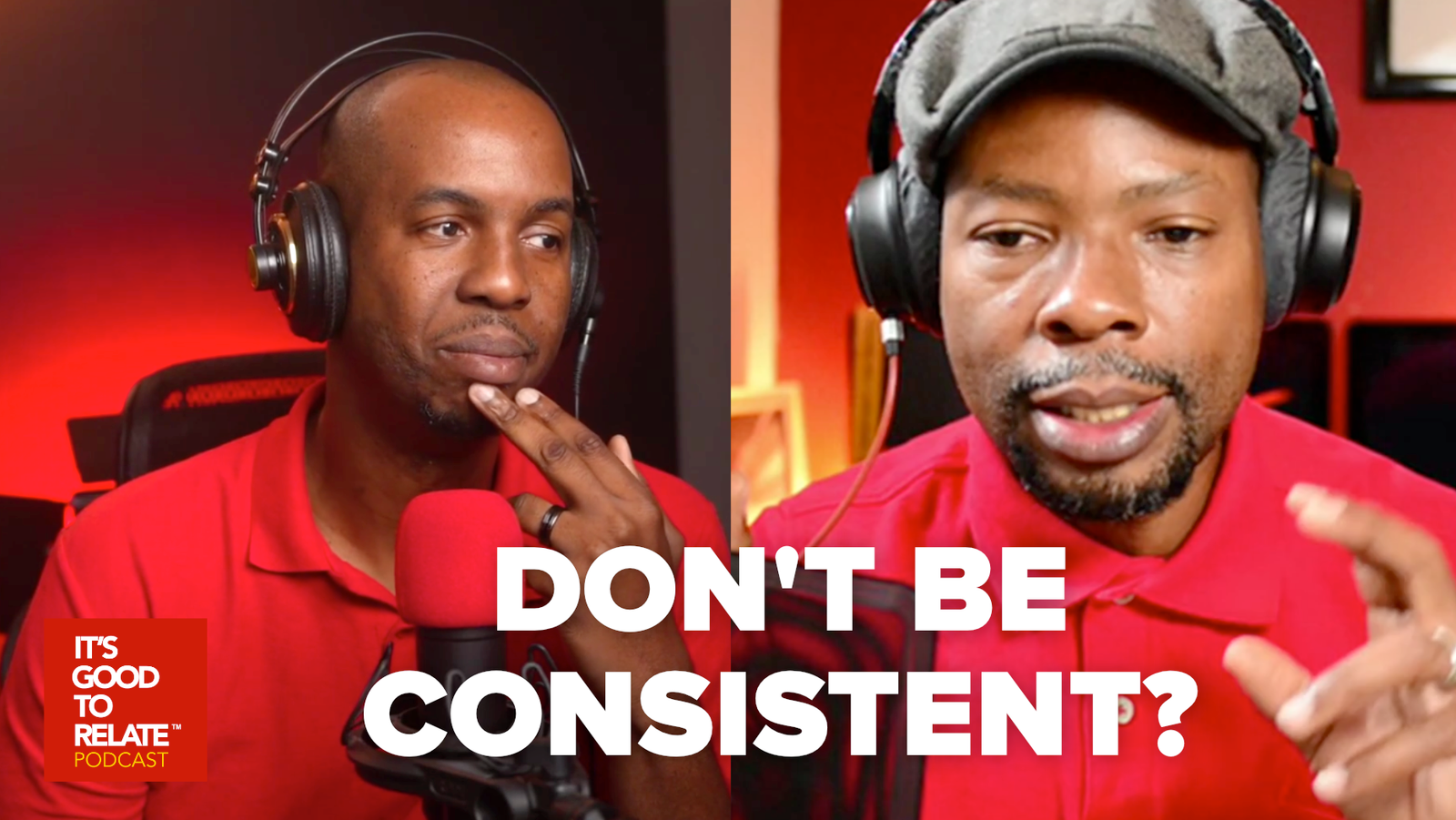


Episode 8 Summary:
The “Consistency” Trap: Why Your Content Strategy Might Be Burning Out Your Team (and Boring Your Audience)
In the relentless pursuit of “the algorithm,” many startup founders and marketing teams have fallen into a dangerous rhythm: posting for the sake of posting. We’ve been told that consistency is the holy grail, but what if that discipline is actually diluting your brand?
In a recent episode of It’s Good to Relate, Juma Bannister and Ayinde Smith sat down to deconstruct the mechanics of content creation. They moved past the generic “just post every day” advice to look at something far more valuable: Efficiency and Relationship Equity.
1. Identify Your Creator Archetype
Juma Bannister argues that before you look at a calendar, you need to look in the mirror. Efficiency isn’t about working harder; it’s about aligning your workflow with your natural “type.” According to Juma, there are three primary categories:
| Type | Name | Style | Best For… |
|---|---|---|---|
| S-Type | Spontaneous | Off-the-cuff, inspired, minimal editing. | Personal brands, TikTok, behind-the-scenes. |
| B-Type | Batch | Scheduled blocks (2–3 hours) to film a month’s content. | Busy CEOs and small teams managing multiple roles. |
| C-Type | Core | One long-form “pillar” (podcast/live) chopped into clips. | Building authority, trust, and high-volume distribution. |
As Juma puts it:
“When you know who you are, then you will find the most efficient way that works for you… You have to choose the type of content creation that allows you to be as efficient as possible.”
For the CEO wearing ten hats or as Ayinde calls it, the “chief cook and bottle washer” batching is often the savior. It moves content from a daily stressor to a quarterly system.
As Promised during the podcast here are Things to Consider for each Creator type:
S-Type:
Many business owners start off like this. They may be testing, trying things out, or may not be comfortable with having a big block of time to create content BUT they have experience and expertise which makes them comfortable sharing on the go. Put more planning into your content (Scripting). Block time for creation
B-Type:
This is for someone who is good planner, likes predictability and values time. You may not write full script but all you topics are pre-planned. You videos are recorded in one location so you have to find an appropriate one, and there will be wardrobe changes because you want the videos to feel different. You can benefit from external expertise, for scripting, production and editing. Even though you can write full script and use a teleprompter, sometimes you may want to just choose a topic and talk from your experience to make it sound more natural.
C-Type:
This is high investment high reward and is a long-term strategy for authority, trust an audience building. Possibly the most technical and production intensive. If you choose a Podcast, it has to be developed and strategy is important. You will likely need a team that would come in provide the expertise to create this type of content, from Strategy to Production to Promotion (Turning your long-form video into clips that can be distributed). Interview shows in particular can be difficult because of the need for guests. There needs to be robust systems for outreach and booking. You’re also going to have to pay for podcast hosting, graphics etc. if you want an audio version of the podcast.
2. The Danger of the “False Idol” of Consistency
Ayinde Smith dropped a truth bomb that might make some LinkedIn gurus sweat: Consistency is overrated. When we prioritize the schedule over the substance, we create “content fatigue.” Ayinde cited a staggering statistic: 55% of marketers report content fatigue in their teams, while 51% of consumers feel the resulting content is generic.
“Consistency could never be the goal. The goal is relationship,” Ayinde noted. “What if we’re wrong? What if [posting 3x a week] is not necessarily the best approach? It sets up a false idol… we start pursuing the consistency and we forget the real intent.”
If your team is burning out to produce “noise,” you aren’t building a brand—you’re just contributing to the “ding in the background.”
3. Quality vs. The Algorithm: The “DIY Perks” Model
To prove that you don’t need to post daily to win, Ayinde pointed to creators like DIY Perks and Juma mentioned Mark Rober. These channels have millions of subscribers despite posting only once every few months.
Why? Because their content is Relevant, On-Brand, and Relationship-Driven.
“Your audience will forgive you [for not posting], especially if you have a direct connection… as long as you continue to meet those expectations,” says Ayinde.
4. The New North Star: Three Questions to Ask Before You Post
If consistency isn’t the goal, what is? Ayinde suggests replacing your rigid calendar with these three qualitative filters:
- Is it relevant? Does it connect to the prevailing context of your business or your audience’s current problems?
- Is it on brand? Does it feel like you, or does it feel like a generic AI-generated filler?
- Does it deepen the relationship? Are you providing “Edutainment” (value + entertainment), or are you just filling a Wednesday 5:00 PM slot?
As Ayinde warned:
“If you’re just filling a slot, that content becomes noise. You wanna be able to stand out… it’s like you see your wife coming up the street—she stands out in a bunch of people. You lock in.”
What did we learn today?
We learned that content strategy for a growing business isn’t about volume; it’s about alignment.
- Efficiency is King: Whether you are a Spontaneous, Batch, or Core creator, find the rhythm that stops you from trading your sanity for views.
- Relationships > Schedules: Consistency is a discipline, but the relationship is the objective. It is better to be less consistent and more relevant than to be “consistently generic.”
- The “Core” Advantage: For maximum ROI, creators should lean toward the C-Type (Core Creator) model—recording one deep, insightful conversation and letting that fuel your entire social presence.
If you stopped posting for two weeks to focus on creating one truly remarkable piece of “Core” content, would your audience miss you, or would they even notice you were gone?